


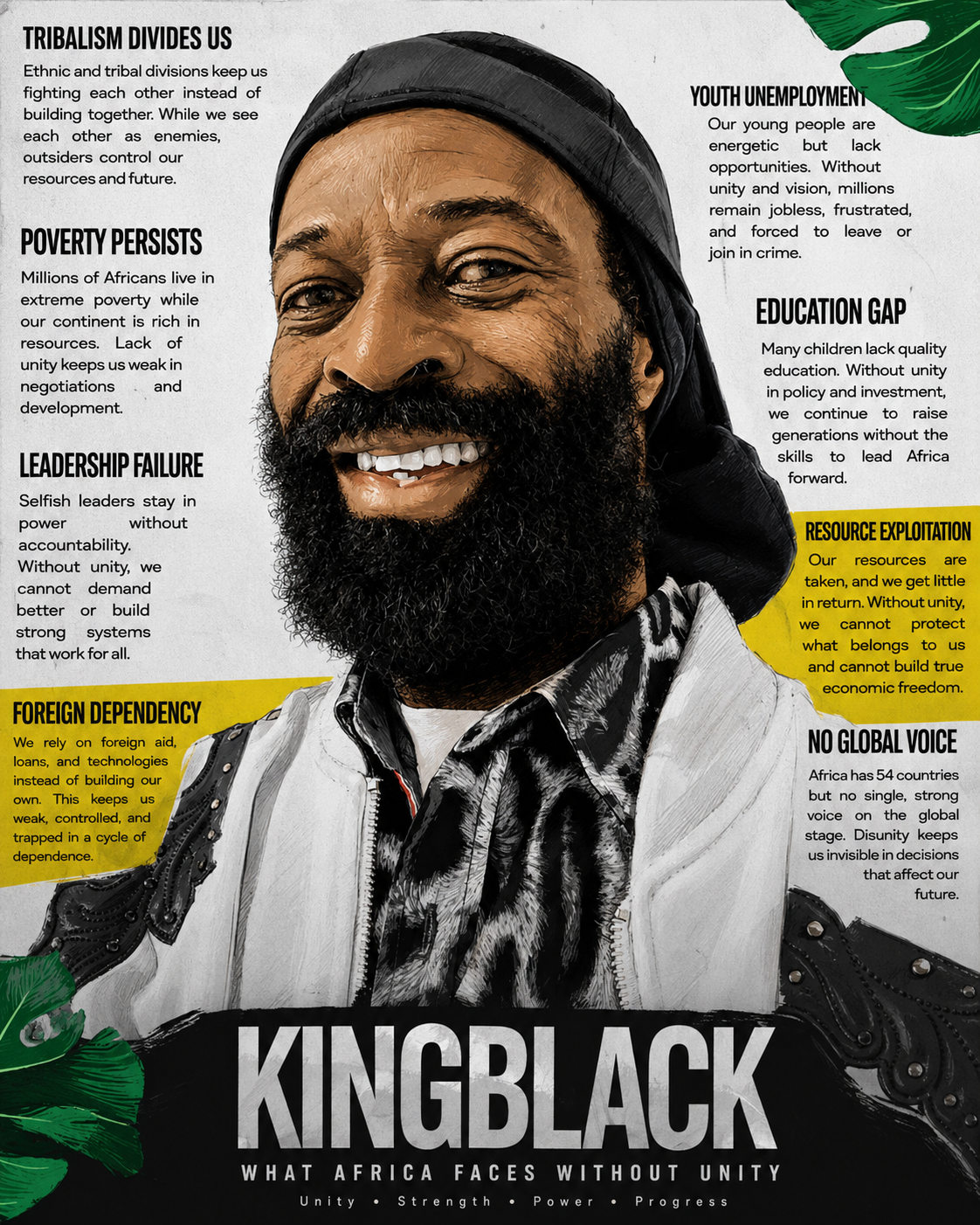
The continent is rich in people, culture and resources. But what happens when those strengths remain divided?
KUBANSOUND MEDIA EDITORIAL
Africa does not lack talent.
Africa does not lack natural resources.
Africa does not lack culture, creativity, intelligence or ambition.
What Africa continues to struggle with is the ability to turn its enormous individual strengths into collective power.
This is not an argument that Africans are incapable of working together. Across the continent, people trade, create, build businesses, make music, develop technology, move across borders and form communities every day.
The deeper problem is structural.
Our countries often operate as separate markets. Our industries frequently compete rather than connect. Our creative ecosystems remain fragmented. Our resources leave the continent in raw form while finished products return at greater value. Our young people inherit borders that often make continental collaboration harder than it should be.
And when Africa negotiates with the rest of the world as fragmented markets instead of maximizing its collective strength, the imbalance becomes obvious.
WE ARE MANY MARKETS — BUT NOT YET ONE POWERFUL MARKET
The African Union's own work on continental integration recognizes that trade barriers have contributed to a fragmented regional economy and have historically positioned Africa heavily as a supplier of raw materials rather than higher-value manufactured goods.
That matters.
Imagine an African entrepreneur who wants to sell a product across the continent.
Instead of seeing Africa as one enormous customer base, that entrepreneur may encounter different currencies, regulations, customs systems, transport networks, languages, payment systems and market restrictions.
The result is predictable:
A business that could have scaled across Africa remains trapped inside one country.
A musician who could have built an African audience struggles to navigate multiple markets.
A filmmaker may have a continental story but lack continental distribution.
A technology company may have a solution for millions of Africans but face fragmented systems.
Unity does not mean every African country must become identical.
It means our differences should become strengths inside a system that allows us to cooperate.
THE PRICE OF DIVISION IS ECONOMIC
The African Union reported that intra-African trade was approximately 16% in its 2023 assessment, compared with much higher levels of regional trade in Europe, North America and ASEAN.
More recent AU reporting shows that the problem remains significant: in 2023, intra-African exports represented about 15% of total African exports, while 85% of Africa's trade continued to flow outside the continent.
These numbers tell a story.
Africa is connected to the world.
But Africa is still not connected enough to itself.
That distinction matters.
We cannot continuously export raw value, import finished value and then wonder why wealth creation remains difficult.
We need stronger African supply chains.
We need African manufacturers buying from African producers.
We need African technology companies serving African markets.
We need African financial systems that make cross-border commerce easier.
We need African creatives collaborating across borders instead of waiting for validation from outside the continent.
And we need African governments to make continental cooperation practical rather than merely ceremonial.
OUR YOUNG PEOPLE ARE PAYING THE PRICE
Africa's population is young, and that can either become one of the continent's greatest advantages or one of its greatest pressures.
The World Bank estimates that Sub-Saharan Africa's population could grow from about 1.5 billion in 2024 to 2.5 billion by 2050, with more than 600 million people joining the working-age population.
That is not simply a demographic statistic.
It is a warning.
Every young African entering adulthood needs more than motivational speeches.
They need opportunity.
They need education.
They need electricity.
They need internet access.
They need functioning infrastructure.
They need capital.
They need markets.
They need industries capable of employing and developing them.
The World Bank has also highlighted the enormous employment challenge facing the continent, including millions of young people entering labour markets while formal employment opportunities remain limited.
If African economies remain fragmented, the young African entrepreneur has fewer customers.
The young engineer has fewer industrial opportunities.
The young filmmaker has fewer distribution networks.
The young musician has fewer connected markets.
The young technology developer has fewer scalable systems.
Unity cannot magically solve unemployment.
But deeper integration can create larger markets, stronger value chains and more opportunities for businesses to grow.
OUR RESOURCES SHOULD CREATE MORE VALUE HERE
Africa possesses extraordinary natural resources.
But possessing resources and controlling the value chain created from those resources are two different things.
Mining a resource is one stage.
Processing it is another.
Manufacturing products from it is another.
Building companies around that industry is another.
Training workers around it is another.
Exporting the finished product is another.
The more stages Africa controls, the more economic value remains within African economies.
This is why continental integration matters.
A larger connected African market can make it easier to develop industries that individual countries may struggle to build alone.
The objective should not simply be:
"How much can Africa export?"
The bigger question should be:
"How much value can Africa create, own and retain?"
UNITY DOES NOT MEAN BLIND LOYALTY
There is another conversation Africa must have.
Unity does not mean defending bad leadership because someone belongs to our tribe, region, religion or political camp.
That is not unity.
That is division disguised as loyalty.
Real unity requires accountability.
It requires Africans to challenge corruption regardless of who commits it.
It requires leaders to be judged by performance rather than identity.
It requires citizens to recognize that another African's success does not reduce their own opportunity.
It requires us to stop treating fellow Africans as competitors simply because they were born on the other side of a national border.
THE CREATIVE INDUSTRY CAN SHOW THE WAY
Music may be one of the clearest examples.
African music has already demonstrated what happens when culture crosses borders.
Afrobeats, Amapiano, Highlife, Fuji, Hip-Hop, Gospel, traditional sounds and countless regional genres continue to travel beyond their original markets.
But the next stage should be bigger than exporting songs.
Africa should build stronger creative infrastructure.
African artists should collaborate across countries.
African labels should form strategic partnerships.
African media platforms should exchange audiences.
African publishers should distribute African stories.
African PR companies should build international campaigns from African perspectives.
African technology companies should build the tools supporting this ecosystem.
The creative economy can become part of Africa's integration story.
And this is where Kubansound Media sees an important responsibility.
Kubansound's stated mission is to bridge African talent with the global stage through media, entertainment, digital strategy, music distribution and international collaboration.
But bridging Africa with the world should never mean abandoning Africa for the world.
The goal should be:
Africa to Africa.
Africa to the world.
And eventually:
Africa with the world — on stronger terms.
WE DON'T NEED ONE AFRICAN IDENTITY
Africa is not one culture.
It is not one language.
It is not one political system.
It is not one music genre.
It is not one experience.
And that diversity should not disappear.
Unity should not erase difference.
Unity should make difference productive.
Nigeria should remain Nigeria.
Ghana should remain Ghana.
Kenya should remain Kenya.
South Africa should remain South Africa.
Senegal should remain Senegal.
Rwanda should remain Rwanda.
Egypt should remain Egypt.
And every other African nation should preserve its identity.
But those identities should be able to cooperate inside a stronger continental framework.
Different nations.
Different cultures.
Different languages.
One continent capable of negotiating from greater collective strength.
THE QUESTION IS NO LONGER WHETHER AFRICA HAS POTENTIAL
The question is whether Africa can organize that potential.
The African Continental Free Trade Area represents one attempt to do exactly that: create a larger continental market and reduce barriers to African trade. The AU describes continental integration as a pathway toward stronger regional value chains, industrialization and economic growth.
But agreements alone are not enough.
Unity must become practical.
It must appear in our businesses.
In our universities.
In our technology.
In our entertainment industry.
In our transportation networks.
In our payment systems.
In our manufacturing.
In our media.
In our political decisions.
And in the way ordinary Africans see one another.
Because if Africans only discover their common interests when outsiders recognize them, then the continent will continue leaving enormous power unused.
KINGBLACK: A FACE FOR THE QUESTION
The KINGBLACK image is therefore not simply a portrait.
It is a question.
What would Africa look like if its people stopped seeing their differences as walls and started using them as bridges?
What if an African filmmaker could reach every African market more easily?
What if an African entrepreneur could sell across borders without unnecessary barriers?
What if African artists could build continental tours and distribution networks?
What if African technology could scale across African economies?
What if African resources were processed closer to where they are extracted?
What if African governments competed on development while cooperating on continental priorities?
What if African youth saw the continent not as 54 disconnected destinations, but as a network of possibilities?
That is the conversation.
Not romantic nationalism.
Not empty slogans.
Not pretending our problems do not exist.
A practical conversation about collective strength.
THE FUTURE CANNOT BE BUILT BY DIVISION ALONE
Africa's challenges are real.
Poverty is real.
Unemployment is real.
Infrastructure gaps are real.
Education challenges are real.
Political instability exists in parts of the continent.
Economic inequality exists.
Resource exploitation exists.
And fragmentation remains an obstacle to deeper integration.
But these problems are not proof that Africa is doomed.
They are proof that Africa has work to do.
The continent already has the people.
The culture.
The resources.
The creativity.
The market.
The ideas.
The question is whether we can build the systems necessary to connect them.
Africa does not need to become one country to become more united.
It needs stronger cooperation.
Stronger institutions.
Stronger markets.
Stronger infrastructure.
Stronger African ownership.
And a generation willing to understand that another African's progress can become part of its own progress.
UNITY IS NOT ABOUT LOSING OUR DIFFERENCES.
UNITY IS ABOUT MAKING OUR DIFFERENCES WORK TOGETHER.
KUBANSOUND MEDIA
Independent African media perspective on culture, business, technology and the global African creative economy.
KINGBLACK — WHAT AFRICA FACES WITHOUT UNITY
Unity • Strength • Power • Progress